
This article includes information about NEXT Pitch English [PR]. It does not promise any test result or specific outcome.
Short answer: Tactical English comes in two kinds: short instructions on the pitch and longer explanations in meetings. The best order is to learn the words that come up in meetings first, then prepare phrases for asking again.
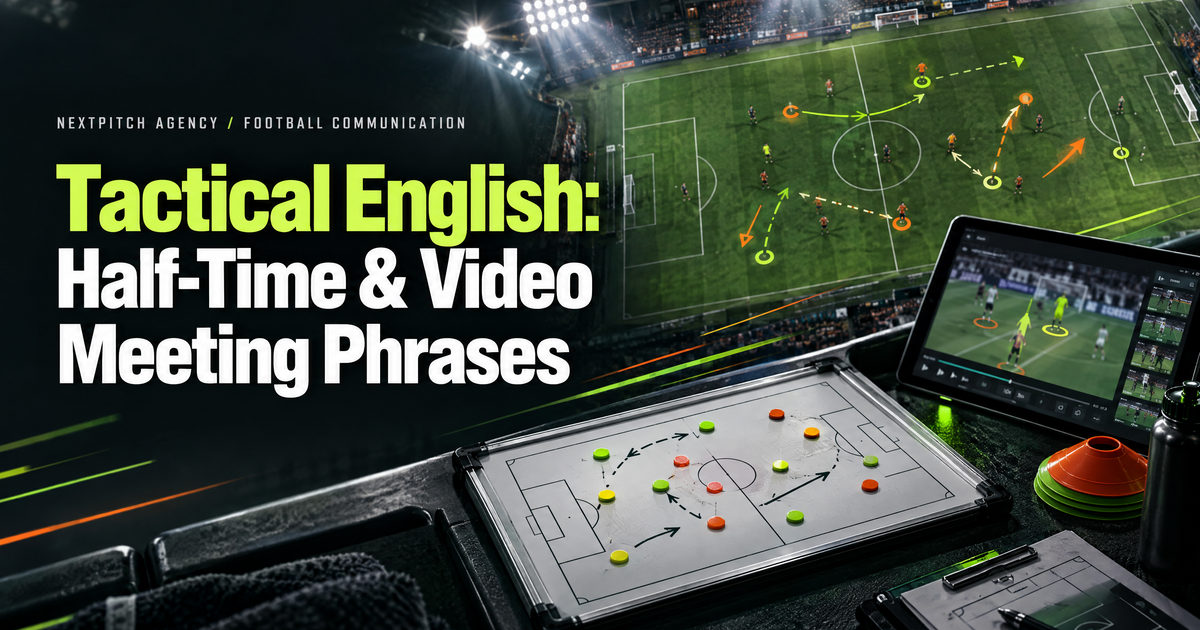
After you get through your first tryout day, the next hard part is often video sessions and halftime. In a video session, the coach pauses the footage and explains positioning and movement in English.
This guide covers the words you will hear there and phrases to use when you don't understand. For the basics of day one, start with English for your first tryout day.
What You'll Learn
- How a video (film) session works and the terms used
- Short halftime instructions
- Attacking and defending tactical terms
- How to ask when you don't understand
- Three steps to learn tactical English
1. How a Video Session Works, and the Language
| Moment | What the coach says | Meaning |
|---|---|---|
| Pausing the clip | Pause it here. | Stop the video here |
| Pointing to positions | Look at our shape. | Look at our team shape (positioning) |
| Identifying a problem | We're too stretched. | We're too spread out |
| Talking about decisions | What are your options here? | What are your choices here? |
| Praising a good action | That's exactly what we want. | This is exactly what we are aiming for |
| Next instruction | Next time, check your shoulder. | Next time, scan over your shoulder |
Tip: Sometimes your own clips are shown and you are asked about them. Practice explaining your thinking, for example: "Can you walk me through it?"
2. Short Halftime Instructions
| English | Meaning |
|---|---|
| Stay compact. | Keep the team close together |
| Press higher. / Drop deeper. | Press higher up / Drop back deeper |
| Win the second balls. | Win the loose balls after the first contact |
| Switch the play. | Change the side of attack |
| Hold the line. | Keep the defensive line |
| Track back. | Run back to defend |
| Show him inside. / outside. | Force him inside / outside |
| Talk to each other. | Communicate with your teammates |
3. Attacking and Defending Tactical Terms
| Category | English | Meaning |
|---|---|---|
| Attack | build-up | Building play from the back |
| Attack | overlap / underlap | Running outside / inside past a teammate |
| Attack | half-space | The channel between the wing and the center |
| Defense | high press / mid block / low block | Pressing high / holding mid-pitch / defending deep |
| Defense | zonal / man marking | Marking space / marking a player |
| Switching | transition | The moment possession changes |
| Switching | counter-press | Winning the ball back immediately |
| Set plays | set piece | Corners, free kicks, throw-ins |
Terms differ by country, club and coach. If you hear one you don't know, it is fine to ask.
4. How to Ask When You Don't Understand
| Situation | English |
|---|---|
| Replay the clip | Can you play that again? |
| Confirm which player | Which player do you mean? |
| Unknown term | Sorry, what does "half-space" mean? |
| Check your understanding | So, I should stay wide and wait for the ball? |
| Ask later | Can I ask you after the meeting? |
Tip: Restate what you understood with "So, ...?" The coach will usually answer "Yes" or "Not quite."
5. Three Steps to Learn Tactical English
- Pick five terms for your own position. You do not need to learn everything.
- Listen for tactical terms in match commentary. Note each one next to its Japanese equivalent.
- Say the asking-again phrases out loud. Being able to ask again matters more than knowing every term.
FAQ
Q. Is tactical English harder than everyday conversation? A. The vocabulary is limited, so learning the common words helps a lot. The hard part is usually longer explanations.
Q. Can a beginner follow a video session? A. Maybe not every word, but footage plus key terms lets you follow the flow. Asking about the rest is part of the plan.
Q. Are the terms the same at clubs abroad and US colleges? A. The basics are shared, but names vary by country and coach. Use the terms your own team uses.
Checklist Before Your First Session
- I can say five tactical terms for my position
- I memorized three asking-again phrases
- I practiced confirming with "So, ...?"
- I noted tactical terms from match footage
Practice Tactical English with NEXT Pitch English [PR]
NEXT Pitch English is practical English conversation for Japanese soccer players aiming to compete abroad. You practice the English used in tryouts, team life, conversations with coaches and meetings, based on experience playing in US college soccer and competing and trying out in Europe.
The goal is not perfect English. It is to reduce the fear of using English bit by bit, so you can hold a conversation from any level. It is not an exam-prep class.
To compare English lesson options, see Recommended English lessons for athletes (2026). For the pathway itself, see the US college soccer guide.
This does not promise any test result or specific outcome. It does not guarantee tryout results, roster spots, scholarships or visas. Terms are general examples and vary by country, team and coach.