
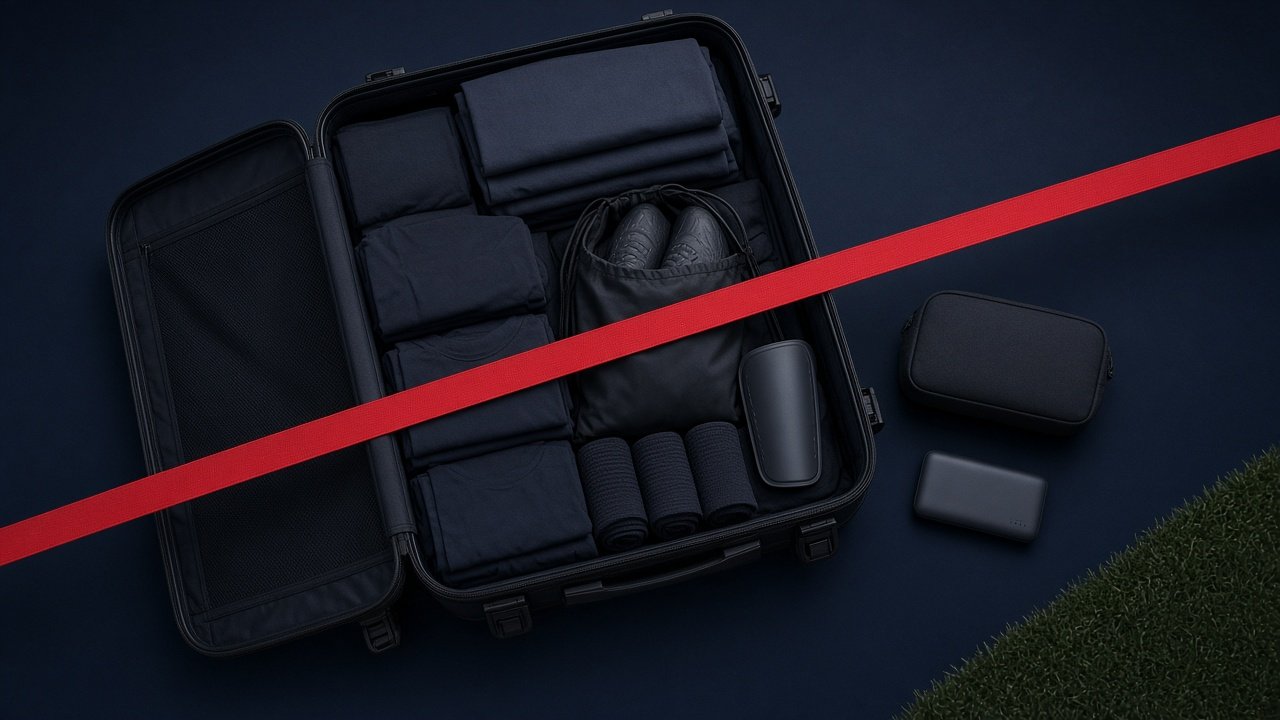
Once a U.S. college soccer commitment is set, the question that stalls many families in the last few weeks is what to pack. Suitcase space is limited. In 2026, airline power bank rules and the conditions for mailing from Japan to the U.S. also changed. On top of that, college soccer players often arrive before other international students, and practice or fitness testing can start the morning after they land.
This guide sorts belongings into four buckets: carry-on, checked bag, buy in the U.S., and ship later (or don't bring). The pre-departure timeline (who does what, and when) is in the parents' 90-day pre-departure plan, so this article focuses on what goes in the bag.
This is general information based on official sources as of October 2026. It is not legal, customs or medical advice. Airline, TSA, CBP, Japan Post, NCAA and team rules change, so always check the official sources before you leave.
Definition (answer first): Packing for U.S. college soccer from Japan works best in four buckets:
- Documents, medications and electronics needed for entry and day one go in the carry-on.
- Sports gear and personal items that are hard to match outside Japan go in checked bags.
- Bedding, heat-producing appliances and everyday supplies are bought in the U.S.
- Everything else is either shipped later or left at home.
Conclusion: decide with four buckets
The short answer is to work through these questions in order when you're unsure:
- Would losing it stop you from entering the country or practicing? Carry it on.
- Is it better chosen in Japan? Cleats, shin guards and familiar personal items go in checked bags.
- Is it heavy, bulky or built to a different standard? Bedding and hair dryers are better bought in the U.S.
- For everything else, ask whether you really need it, then ship it or skip it.
Aim to be ready to practice on day one rather than packing everything just in case, and the bags get much lighter.
The four buckets at a glance
Each bucket has a job. Look at the whole picture first, then fill in the details.
| Carry-on (with you) | Checked bag | Buy in the U.S. | Ship later or don't bring | |
|---|---|---|---|---|
| What goes in (examples) | Documents, prescription meds, laptop/phone/chargers, power banks, one practice kit, one pair of cleats, shin guards | Spare cleats, GK gloves, insoles, casual clothes, warm layers, familiar toiletries | Twin XL bedding, hangers, detergent, hair dryer and other heat appliances, stationery | Off-season clothes, bulk food, large appliances |
| Why | Losing them blocks entry or day-one practice | Better fit is easier to find in Japan | Heavy, different standards, or cheaper locally | Mail rules are stricter and costlier |
| Impact if lost | Very high | High (prepare to last a few days) | Low | — |
| 2026 note | Power banks: max two, no in-flight charging | No power banks | Check the dorm's banned-appliance list | U.S.-bound mail resumed with conditions |
Carry-on: one bag for entry and the first 72 hours
The carry-on gets you through entry and your first few days. Pack it so you can practice even if your checked bags don't arrive.
Document pouch (never check originals)
Keep these together:
- passport and F-1 visa
- signed I-20 and SEVIS I-901 payment receipt
- admission letter
- copies of financial and aid documents
- proof of insurance
- immunization records
What each one means is covered elsewhere: F-1 visa interview, I-20 and financial proof, immunizations and medical clearance, and international student health insurance. Besides the paper originals, save scans to your phone and the cloud, and give family a copy.
Money and cards
Carry a small amount of U.S. cash and two internationally accepted cards, kept in separate places. Bank accounts, SSNs and phones are set up after arrival; see the first-month U.S. setup guide.
Plan for the morning your bag doesn't show up
At some schools, practice or testing starts the morning after report date. Pack the carry-on so you won't be stuck without your checked bags:
- one practice kit and socks
- one pair of cleats and shin guards
- two days of clothes and basic toiletries
The TSA's page lists sports cleats as allowed in both carry-on and checked bags. The final decision rests with the TSA officer.
Electronics and power banks (new 2026 rules)
According to Japan's Ministry of Land, Infrastructure, Transport and Tourism (MLIT), after an emergency revision to International Civil Aviation Organization (ICAO) standards, these rules apply to carrying power banks onboard from April 24, 2026:
- A maximum of two power banks in the cabin, each 160 Wh or less
- Don't charge power banks onboard
- Don't use power banks to charge other devices onboard
Power banks were already banned from checked baggage, and those over 160 Wh can't be carried at all. You're also asked to keep them with you rather than in the overhead bin. Some airlines set stricter rules, so check your carrier as well.
The U.S. Federal Aviation Administration (FAA) also allows spare lithium batteries, including power banks, in carry-on baggage only. If your bag gets checked at the gate, remove the batteries and keep them with you in the cabin.
Early move-in reality
Players who move in early for preseason sometimes start in a temporary room and move to their fall room later. A first-week bag lets you live without unpacking everything. For timing, see preseason report dates.
Sports gear: bring from Japan, provided by the team, or buy in the U.S.
Ask the team what's provided before you shop. There's no need to buy lots of practice gear in Japan if the team supplies it.
Ask the team first
Email to check what's provided (practice gear, training shoes, bags, jerseys, rain gear) and what you bring yourself (cleats, shin guards, GK gloves):
"Could you tell me which items the team provides, such as practice gear, bags and rain jackets, and which items I should bring myself, such as cleats and shin guards?"
Team gear usually comes from the university's apparel partner. Some schools ask players to keep other brands' marks from showing during practice and games, though this varies. Also ask about return rules for team-issued gear.
Cleats
If a Japanese brand fits your foot best, get it in Japan. U.S. stores may stock fewer sizes and widths. Many colleges train and play on artificial turf, so some players bring about two pairs suited to different surfaces. Break new cleats in at home to avoid blisters on day one.
Shin guards, GK gloves, insoles
Bring your own shin guards and any insoles or supports you're used to. GK gloves wear out, so bring spares.
Tape and ice
Many schools' athletic training rooms supply these. Bring only personal items you're used to, not bulk supplies.
Balls
You'll mostly use team balls. If you bring one, deflate it and pack it in a checked bag.
Gear costs
Gear is often not covered by athletic aid. For the bigger picture, see true out-of-pocket costs. For getting physically ready after you arrive (lifting and fitness tests), see strength and conditioning in U.S. college soccer.
Electricity: Japan 100V, U.S. 120V
Phone and laptop chargers usually work as they are. Heat-producing appliances such as hair dryers are the ones to watch.
Voltage and plugs
Japan uses 100V and the U.S. uses 120V. Outlets in both countries take a very similar two-flat-pin plug (Type A), and three-hole outlets are common in the U.S. If your phone, laptop or camera charger says "INPUT 100–240V," it usually works as is. The idea that you always need a plug adapter is mostly a myth, but there are exceptions, such as three-pin devices. Check each device's label.
Heat-producing appliances
Hair dryers, straighteners, rice cookers, electric kettles and electric blankets made only for 100V can break or overheat on 120V. Buy them in the U.S. or check the voltage rating.
Dorm-banned appliances
Which appliances dorms allow (kettles, extension cords, heaters and so on) varies by school. Check the rules, and see first-year dorms and homestays.
Phone and laptop
Check in Japan that your phone is unlocked and eSIM-capable. Laptop specs and required software are in the university's guidance (for registration, see course registration and academic advising).
Want help choosing a school where day one is ready, with gear, housing and arrival timing included? You can send us your situation. We don't promise entry, customs or eligibility outcomes, but we can help you plan the order of steps.
Medications, kampo and supplements: entry rules plus athlete checks
Medications need checking from two angles: U.S. entry rules and NCAA banned substances. Some Japanese cold medicines, herbal (kampo) remedies and supplements may need extra care depending on their ingredients. This is not medical advice.
Entry basics
U.S. Customs and Border Protection (CBP) directs travelers to follow Food and Drug Administration (FDA) and related rules for medications. The usual basics are:
- the medication is for personal use
- it stays in its original container or packaging
- you carry the prescription details in English, such as a doctor's letter
Check official sources for quantities and controlled ingredients before you go. Keep prescription meds in your carry-on.
Athlete checks: NCAA banned substances
The NCAA's 2026–27 banned substances list includes these stimulants as examples:
- ephedrine
- caffeine and sources of caffeine (green tea extract, guarana, yerba mate and others)
- synephrine (bitter orange)
Some Japanese cold medicines, kampo containing ephedra (mao), energy drinks and imported supplements may contain these, depending on ingredients.
The same list states: "Phenylephrine, Pseudoephedrine and Oxymetazoline (excluding the oral route) are not banned." Don't interpret exceptions like this on your own. Always check.
The NCAA also states:
- There are no NCAA-approved nutritional or dietary supplements.
- Supplements may be contaminated with banned substances not listed on the label.
- Supplements are taken at the student-athlete's own risk.
Write down the ingredient names of any medications or supplements in English, and check them with your athletic trainer after you arrive. The NCAA points to Drug Free Sport AXIS (axis.drugfreesport.com) for ingredient review.
PPE forms
List regular medications on your preparticipation exam (PPE) history form.
Contacts and glasses
Bring your prescription details in English and spares. In the U.S., buying contact lenses requires a prescription.
What to buy in the U.S.
Heavy, bulky or different-standard items make more sense to buy in the U.S. Just confirm in advance that you can get to a store soon after arriving.
Bedding
U.S. dorm beds are usually Twin XL (about 39 × 80 inches). Japanese single sheets often don't fit. Bring one light sheet set for the first night, or make sure you can buy one on arrival day.
Stores and online
Many students set up their rooms from stores like Target, Walmart and Costco, Amazon, or the campus bookstore. Whether you can ship to the dorm ahead of time depends on mailroom rules. Some schools won't accept packages before move-in.
Early move-in without a car
Arriving early for preseason, you may not know anyone with a car yet. Ask team staff how the first shopping trip works, whether that's a team run, an upperclassman or a rideshare.
Winter gear
In snowy regions, buying outerwear and boots locally often makes sense. Base layers are handy to bring from Japan.
Shipping later, or not (2026 mail and duties)
Planning to "just ship it later" takes more effort and money in 2026. If you do ship, keep it small and declare it correctly. This is not customs or legal advice.
Japan Post mail to the U.S.
Japan Post's July 14, 2026 notice says:
- Since April 14, 2026, designated post offices have resumed accepting some mail to the U.S.
- From July 24, 2026, items valued over $100 and up to $2,500 need duty prepayment, registered through an approved provider's app. They must carry the resulting DDP label and be sent from designated post offices.
- Documents and personal gifts of $100 or less can be sent without prepayment.
- Items of $100 or less that aren't documents or personal gifts are still listed as needing prepayment at designated offices.
- Items worth over ¥200,000 also need a separate Japanese export declaration.
Conditions can change, so check Japan Post's latest notice before sending anything.
Food
Food must be declared, and products containing meat extract, for example, may not be allowed in or mailed. For everyday eating, see meal plans and nutrition for college soccer players.
If family sends things
The simplest route is documents and small personal gifts ($100 or less). Ask your player for the exact format of their dorm mailroom address and box number.
Suitcase strategy: how many, how heavy, how to split
Checked bag allowances vary by airline, route and fare. Check them, including any connecting flights, before splitting your load.
Allowance example
ANA's international economy guidance gives up to 23 kg (50 lb) per bag and 158 cm (62 in) in total dimensions; the number of bags depends on route and fare. If a U.S. domestic connection is on a separate ticket, that flight's baggage rules and fees may apply.
A sample setup
- One large suitcase: clothes and gear
- One medium suitcase: daily-life items
- One carry-on: the 72-hour kit
- One backpack: documents, laptop, meds and power banks
Weigh everything at home.
Packing gear
Bag your cleats, deflate balls and wrap fragile items in clothing.
Lost-bag prep
Photograph what's in each bag, attach contact tags, and make sure the carry-on alone can get you through two days.
Winter break and summer storage
For summer storage when dorms close, see the dorm guide linked above. For winter break trips home and re-entry documents, see travel home on breaks for F-1 players.
Clothing: travel dress codes and seasons
Besides practice gear, bring one or two smarter outfits for team travel and events.
- Travel and banquets: some teams specify polos and chinos. Bring one or two collared shirts and clean shoes.
- Interviews and career events: you can buy these locally when needed.
- Fall night games: pack layers and rain gear for temperature swings.
How parents can help from Japan
Parents can help by keeping document copies, suggesting local purchases first, and sending only small, correctly declared items.
- Keep scans of documents and an English note of medication ingredients.
- When something's missing, suggest buying it locally first.
- If you send something, keep it small and declare it accurately.
For the full pre-departure flow, see the 90-day plan linked at the top.
Night-before checklist (10 items)
- Document pouch (originals with you, copies in three places)
- Two cards and a little U.S. cash
- 72-hour kit (practice kit, cleats, shin guards)
- Charger "INPUT" labels checked
- Power banks: two or fewer, 160 Wh or less, in carry-on
- Medications in original packaging with English notes and ingredients
- Team-provided items confirmed
- A plan for getting sheets
- Suitcases weighed
- First shopping trip arranged
Eight common stumbles
Most stumbles come from not checking the rules or not asking the team.
- Putting original documents in checked bags
- Checking power banks, or bringing three or more
- Bringing a hair dryer because "you need an adapter" and frying it
- Buying lots of practice gear without checking what's provided
- Bringing only natural-grass cleats to a turf school
- Taking Japanese cold medicine, kampo or supplements without checking
- Bringing single sheets that don't fit a Twin XL bed
- Assuming you can ship later without knowing about duties and designated post offices
The NextPitch view
NextPitch focuses on fit, not famous names. Packing is preparation for being ready to practice on day one. If you check team-provided gear, dorm setup and arrival timing while choosing a school, looking past the name, pre-departure prep gets much lighter. For the full picture of U.S. college soccer, start at our college hub.
For when family visits later, see parents' campus visits.
FAQ
How many suitcases should I bring? Allowances vary by airline and fare, so check first. One large, one medium, one carry-on and a backpack is one common setup.
How many pairs of cleats? Can they go in carry-on? Some players bring about two pairs for different surfaces. The TSA lists cleats as allowed in both carry-on and checked bags, but the officer decides.
Do I need a plug adapter or voltage converter? Japanese and U.S. outlets are very similar, and most chargers handle 100–240V. There are exceptions, so check each device. Buying heat appliances in the U.S. is the safe choice.
How many power banks can I bring? Per MLIT, from April 24, 2026, you can bring up to two in the cabin (160 Wh or less each), and charging onboard isn't allowed. They can't go in checked bags.
Can I bring Japanese medicine, kampo or protein? Check both U.S. entry rules and NCAA banned substances. Note ingredient names in English and check with your athletic trainer after arrival.
Can family ship things from Japan? What about duties? Through Japan Post, items over $100 and up to $2,500 need duty prepayment. Documents and personal gifts of $100 or less don't. Check the latest conditions.
Next step
If you'd like help choosing a school where day one goes smoothly, with gear, housing and arrival timing included, apply for a consultation. We don't promise entry, customs or eligibility outcomes, but we can help you plan the order of steps.