
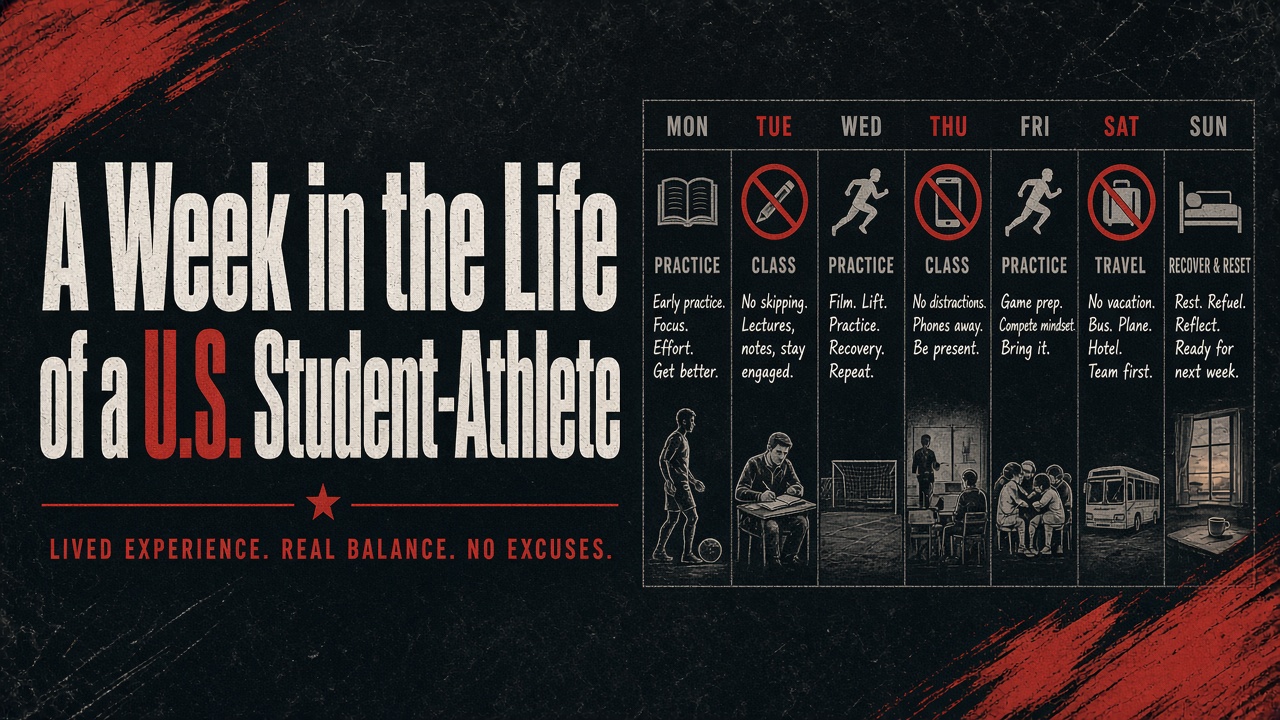
Life is not a highlight reel. A U.S. student-athlete week stacks training, class, recovery, and English-language life admin. Families that skip this reality before recruiting often send a player to “go play soccer” and watch sleep, grades, and confidence crack in semester one.
Bottom line: in fall competition especially, sessions, coursework, travel, and self-management run in parallel. Universities provide coaches, trainers, and academic advisors—but the default setting is self-management. Starting roles are not promised. Full rides are not the norm.
What a week often includes
Details vary by division, program, position, and year. International players still tend to be surprised by the same clusters:
- Training — pitch work, gym, activation, cooldown
- Film — team meetings, individual clips, set-piece detail
- Recovery — sleep, nutrition, treatment, travel fatigue
- Class — real university credits: lectures, discussion, deadlines in English
- Travel — missed class is expected; early submissions and professor emails come with it
- Life — dorm or apartment, banking, insurance, groceries, teammates and loneliness
The story is not only “practice is hard.” The story is hard practice followed by an English paper due at midnight.
Fall vs spring rhythm
For many NCAA programs, fall carries the official season and spring emphasizes training and evaluation (exact shapes differ by association and school). Fall maximizes travel-versus-class conflict. Spring is not easy mode—it restarts body load and roster competition. Off periods still demand conditioning. A Japanese high-school “off = full stop” mindset leaves players behind. Recovery is required; blank weeks are not the plan.
Who tends to thrive (habits over hype)
Talent is not enough. These habits travel well:
- Time management—or willingness to learn it on a real calendar app
- Coachability without emotional shutdown
- Academics treated as half the job, not optional
- Imperfect English paired with the courage to ask and confirm
- Ability to seek help under homesickness or reduced minutes
- Sleep and food treated as performance tools
Athletes whose parents or coaches previously ran every schedule often stall in month one. Practice owning deadlines before you fly.
What families should know
- Starting XI minutes are earned in a competitive roster, not guaranteed in a welcome email
- Injury, fewer minutes, and academic dips happen—Plan B is maturity, not failure
- Cross-time-zone family calls need rules that protect sleep
- Extra costs appear (flights home, visa-related fees, break housing)
- Campus support exists to be used; unused resources are not proof of independence
Parental worry is normal. Turning worry into daily interrogation blocks adult habits. A weekly call slot, a shared calendar, and agreed academic alerts work better.
Travel-week reality
Road trips are not only fun match days.
- Submit work before departure
- Email professors about absences (keep an English template)
- Protect nutrition and sleep in transit
- Expect class the day after you return
- Partner with trainers without outsourcing all body awareness
Language fatigue stacks on top of match fatigue. Asking an academic advisor early is student-athlete behavior—not weakness.
Sample non-travel weekday (illustrative only)
- Morning: commute/activation, class
- Afternoon: class, assignments, short rest or treatment
- Evening: team session, gym
- Night: food, brief film, coursework, sleep
Social media shows the goal. It hides the 10 p.m. assignment and the drafted English email.
Prep you can do in Japan
- Memorize a polite absence-email template for professors
- Run your own weekly calendar for 30 days before departure
- Stop “succeed by cutting sleep” study patterns
- Avoid extreme nutrition swings
- Decide in advance that you will identify help contacts in week one on campus
Athlete checklist
- Can place a week of tasks on a personal calendar
- Can picture early submissions before travel
- Reviews coaching with notes or film
- Can ask for help in one English sentence
- Treats sleep as performance
- Can accept non-starting scenarios
Family checklist
- Talked about life beyond highlights
- Agreed contact cadence
- Listed likely extra costs
- Defined response if academic warnings appear
- Can support a story that is not only winning
Where Japanese athletes commonly stall in semester one
- Participation grades and group-work norms that differ from home
- Delayed travel emails that create credit risk
- Falling behind in team English and never asking
- Heavy family reporting duties that cut sleep
- Treating reduced minutes as shame and drifting from trainers/advisors
The fix is usually not a new skill move. It is templates, calendars, and named help contacts. Strength as a student-athlete includes the judgment to use support.
Building a personal operating system before you fly
Spend thirty days in Japan running the system you will need abroad: weekly calendar blocks for training, study, sleep, and admin; a shared folder for PDFs; a simple injury/availability log; and two drafted emails—one to a professor, one to a staff member asking for clarification. If that system feels annoying at home, it will feel impossible in a new language and time zone. Make the boring tools boring before the stakes rise.
Feed this reality back into recruiting
Once you see the weekly machine, you stop choosing on logo and scholarship percentage alone. Ask about travel load, academic support, history with internationals, and whether your time-management habits fit that rhythm. FIT is chemistry with a week you can repeat—not a trailer of goals.
Next step
Start with the U.S. college soccer guide.
A student-athlete is a university student and a competitor at once. Families who share that weekly reality make sharper recruiting choices—and softer landings.
Your Next Pitch Starts Here.