
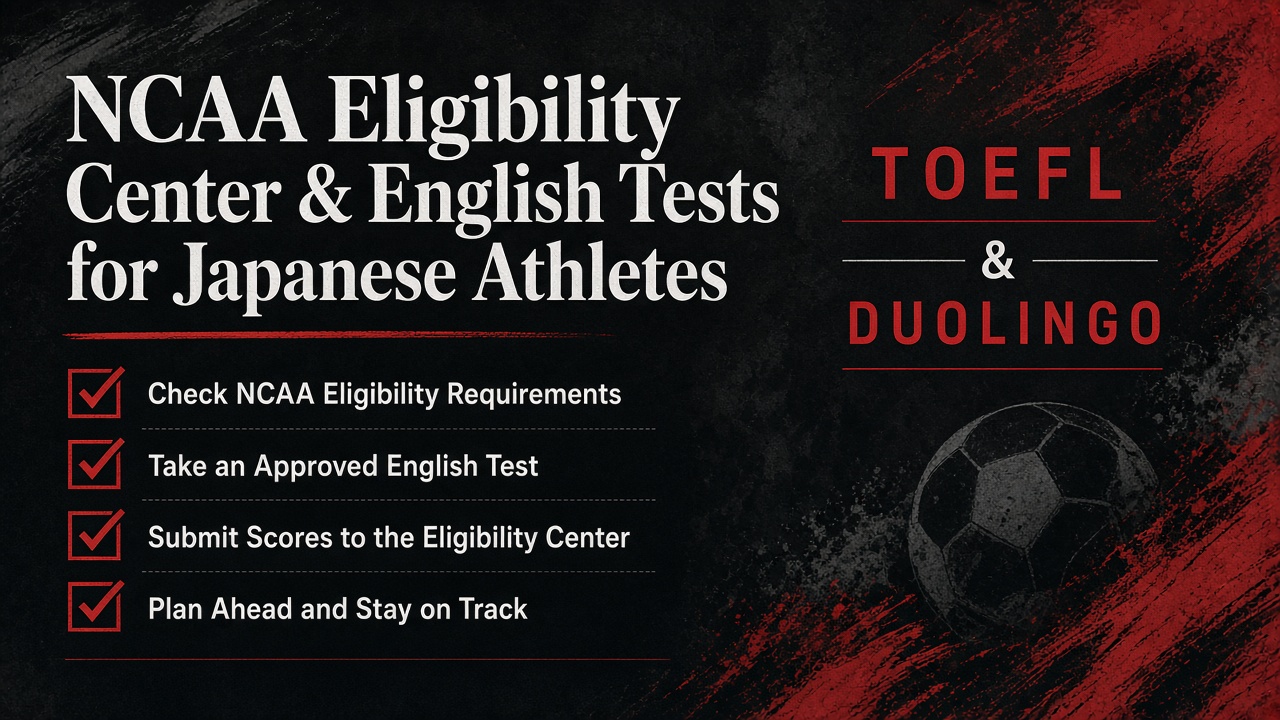
Strong soccer does not unlock eligibility or admission by itself. Japanese players aiming for U.S. college soccer often stall less on technique than on treating eligibility, university admission, and English scores as one form. They are separate tracks. Slip one calendar and the whole recruiting plan wobbles.
Bottom line: many NCAA paths require Eligibility Center work plus academic and amateurism tracking. English tests (TOEFL, Duolingo, and school-specific options) are usually an admissions requirement for international students—manage them on their own timeline. Coach interest is not admission, not clearance to compete, and not a visa.
To compare test format, fees, and score scales, see TOEFL vs Duolingo vs IELTS: choosing your English test.
Eligibility ≠ admission ≠ English ≠ visa
Keep four columns:
- Eligibility — association competition rules: academics, amateurism, registration steps
- Admission — whether the university accepts the academic profile
- English requirement — scores or alternatives a school demands of international students
- Immigration — status steps that generally follow admission (remember “separate,” even before you deep-dive paperwork)
FIT families table these columns early so “the coach replied” does not get misread as “we’re done.”
What the NCAA Eligibility Center is for (high level)
If you are exploring NCAA programs, learn this first: school applications and association certification are different jobs. The Eligibility Center is a common entry point for academic and amateurism-related checks tied to NCAA competition. Exact requirements vary by year, division, and first-year vs transfer status—verify current official guidance for your case.
Practical habits for Japanese high-school athletes:
- Do not postpone registration until the last recruiting month
- Build lead time for transcripts, graduation documents, and certified translations
- Answer playing-history and compensation questions clearly—amateurism issues hate vagueness
- Do not treat a coach’s verbal “you should be fine” as your official status; track it yourself
NAIA and NJCAA are different associations with different processes. “Everything is Eligibility Center” is a route error. Once your association hypothesis is clear, follow that association’s official steps.
Academics: why Japanese transcripts show up late—and hurt
Early recruiting highlights film. Later stages highlight grades and graduation requirements. If academics slide through Grade 11–12, the programs you like feel suddenly strict.
Do this early:
- Keep a term-by-term grade map; repair weak subjects before senior year panic
- Ask your Japanese high school how long official English documents take
- Map graduation requirements to documents U.S. schools request
- Do not excuse weak classroom performance because soccer is strong—continued failures can cost competition
Academics are half the student-athlete contract, not an errand.
Choosing TOEFL, Duolingo, or another path
English scores are for university international admissions—not for impressing a coach in email. Accepted tests and minimums differ by school. Picking one exam before you have even a draft list often forces a redo.
A workable sequence:
- Draft a realistic school list (keep it bounded—under ~20 while testing)
- Spreadsheet each school’s English rule: test types, minimums, deadlines, conditional options
- Prioritize a test accepted by most of your list; lock exam dates onto the recruiting calendar
- When scores post, confirm official reporting method
- If short, schedule retakes before move-prep season eats the calendar
There is no universal winner between TOEFL and Duolingo. Acceptance, logistics, target score, and how you study decide. “My teammate used Duolingo” is not a policy. Score validity windows matter—too early and too late both create risk. Many families aim for a score peak from late Grade 11 into early Grade 12, adjusted for the athlete’s learning curve and list.
Amateurism and playing history—questions Japanese athletes hear
Club, academy, sponsors, stipends, pro-adjacent environments—Japanese pathways are diverse. Vague answers create expensive corrections later. Write a factual timeline. If something is unclear, get guidance early rather than hiding details.
Family integration checklist
- Table with columns for eligibility / admission / English / visa
- Association hypothesis written (NCAA / NAIA / NJCAA, etc.)
- Registration timing understood for the relevant body
- Transcript and graduation document lead times confirmed with the high school
- Playing-history timeline ready for questions
- English test type and targets matched to the school list
- Exam dates placed on the recruiting/application calendar
- Official score-reporting steps confirmed
- Family can say out loud: coach interest ≠ admission ≠ clearance
- “Last verified on [date]” noted because rules update
Failure modes we see repeatedly
- Parking English until the month before departure
- Discovering translation/issuance delays only after an offer talk
- Researching only NCAA Eligibility Center while pursuing another association
- Treating verbal reassurance as certified status
- Leaving portal deadlines only in the athlete’s head
Important caveat
Association rules, English policies, and document standards change by year, school, and individual history. This article is a planning frame for Japanese player families—not a guarantee of eligibility or admission. Confirm with current official sources and, when needed, university compliance contacts.
A sample 90-day runway into application season
Example only—adjust to the athlete:
- Days 0–14 — draft school list, spreadsheet English rules, read the relevant association’s current steps
- Days 15–45 — sit the English exam (or mock→official), request transcripts, draft playing-history timeline
- Days 46–70 — reshape the list from scores, book retakes if needed, refresh the recruiting profile
- Days 71–90 — gap-check applications, store proof of submissions, hold a family deadline review
Do not run “English only” or “film only” sprints. Eligibility, admission, and English have to coexist on the same 90 days.
Next step
Start with the U.S. college soccer guide.
After film, put eligibility and English on the same wall calendar as recruiting. Once the three tracks are visible, “hurry” and “wait” become concrete.
Your Next Pitch Starts Here.