
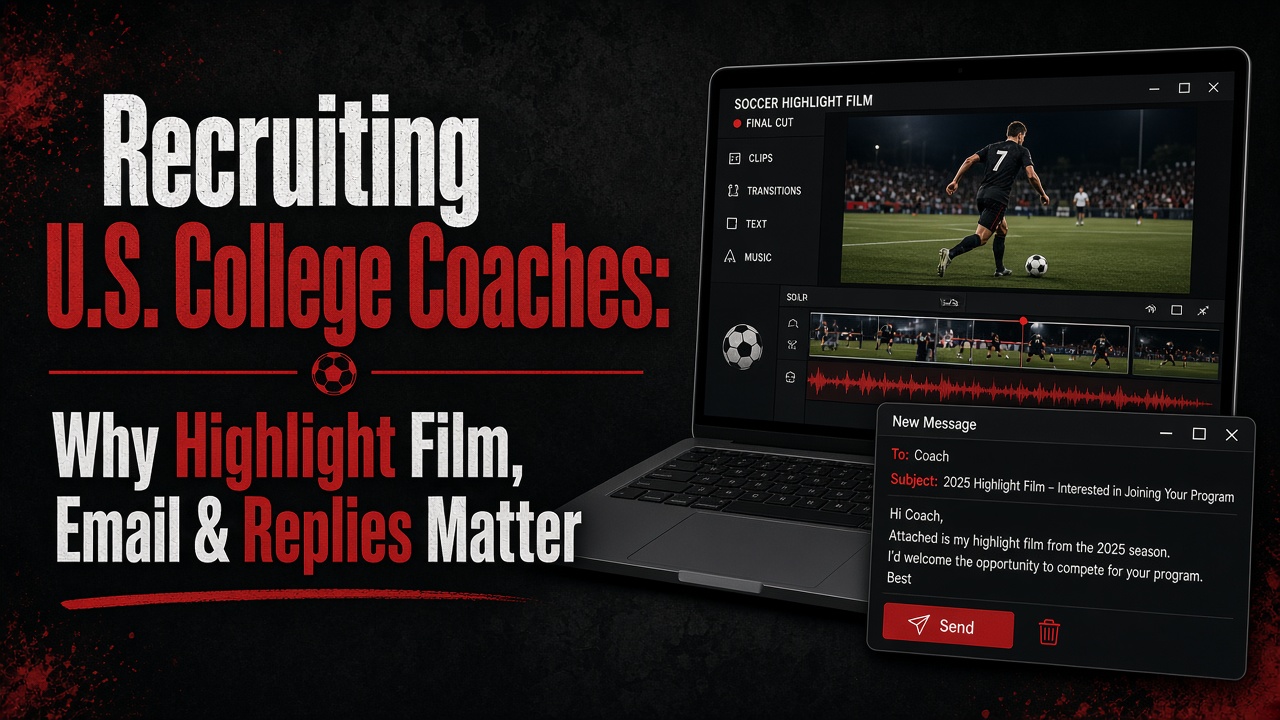
The core of recruiting is not flashy selling. It is delivering a set that can be evaluated.
Bottom line: highlight film + English email + athletic resume (results, academics, physical profile) is the base package. How you send it—and how fast you reply—is part of the evaluation. This guide is for Japanese players searching "college soccer recruiting": coach-side failure modes, an email template, stage differences, and a pre-send checklist. Being good is not enough. Coaches ask whether you can last in this program.
The set coaches actually open
- A short highlight where your position is obvious
- Full match or long cuts when possible (decisions, defending, intensity)
- Class year, position, height/preferred foot, club/high-school history
- Academics (grades, graduation timeline, English test status)
- Contact paths you can actually answer in English
- One sentence on why this program
Coaches receive film links constantly. Players who are easy to compare survive the pile. Passion essays lose to clarity that can be forwarded, compared, and saved.
Common film mistakes
- Too long / music as the star / goals only
- Editing that hides who to track
- Only old clips with no recent intensity
- Broken links, login walls, mobile-unfriendly players
- Japanese-only captions with no coach-readable context
- Wide team shots that hide individual decisions
- "Show everything" edits with nothing in the first 15 seconds
In the first seconds, a coach should know which position and what to evaluate. Highlights open the door. Full matches, conversation, and academics close the decision.
Why full matches / long cuts matter
Assuming highlights alone produce offers is dangerous. Coaches often want:
- Off-ball movement
- Defensive intensity and recovery runs
- Response after mistakes
- Set-piece roles
- Consistency of decisions across game flow
If you cannot produce a full match quickly, you can be deferred as "incomplete materials." Filming habits from Grade 10–11 make this far easier.
A short English email template
- Who you are (name, class year, position, country)
- Why this program (one concrete line—style, major, roster need)
- Academics / English status (do not hide)
- Film links + resume/profile
- Clear next action (call, extra film, camp availability)
Subject lines are an evaluation door too. Vague "Interested player" opens less often than subjects with class year, position, country. Long self-praise, emoji walls, and identical blasts to every coach can cost you points before film loads.
Athletic resume (one page that compares)
Do not dump everything into the email body. Use one page (or a short profile) for:
- Basics (name, DOB, year, position, physical)
- Club / high school / national history (facts only)
- Academics (GPA equivalent, graduation plan, English scores or test dates)
- Film links (highlight / full)
- Contact + time zone
Inflated résumés destroy roster trust later. If something is pending, write "scheduled" or "in progress."
Why replies are part of the evaluation
Speed and care on camp invites, follow-up questions, and document requests preview how you will communicate on the roster. Read-and-ignore habits or careless English can deduct points before the ball is kicked.
Japanese players living across time zones win by deciding this early:
- Who sends the first reply (athlete vs limited parent support)
- Habit of acknowledging within 24–48 hours even if detail comes later
- Answering with film, academics, and calendar in one place
- Never using "busy" as a reason for silence—send a short status instead
Verbal interest ≠ offer ≠ visa
| Stage | Meaning | Common family misread |
|---|---|---|
| Interest / ongoing contact | Still evaluating | Spot locked / decided |
| Offer / aid talk | Condition-check phase | Money and admission locked |
| Admission | Academic process at the university | Visa finished |
| Visa | Separate process | Coach handles everything |
Skipping order breaks family judgment and calendars. Fast replies do not equal a higher stage. At each stage, ask what document is actually required now.
Bridging to calls and camps
After strong email and film, calls and camps often follow.
- Calls: English intro, questions, honest academics
- Camps: on-site intensity, coachability, interpersonal signals
- Paid camps are not mandatory for everyone—weigh ROI and whether the camp fits your level band
"Camp = offer" is another myth. Weak materials stay weak on the field.
Pre-send self-audit
- Position is clear in the first 15 seconds
- You have highlight + full (or long cuts)
- Links play on mobile without login
- Email is short with one program-specific line (low copy-paste feel)
- Academics/English are honest
- Resume/profile is scannable on one page
- Reply system exists across time zones
- Target band is realistic (not DI-only spray)
- Family understands interest / offer / admission / visa
Timing and cadence for outreach from Japan
Sending once and waiting months is a common failure mode. So is daily follow-up. A workable cadence for many Japanese players:
- Initial email with film + resume + honest academics
- Polite follow-up in 10–14 days if no reply (new subject line, same clarity)
- If a coach engages, answer within 24–48 hours even across time zones
- Update film when you have a meaningfully newer full match—not every tiny clip
- Stop blasting the same DI list after silence; widen or retarget the band
Keep a simple tracker: school, coach email, date sent, reply status, next action. Recruiting is operations, not vibes.
What "good English" means in recruiting (it is not IELTS poetry)
Coaches are not grading literature. They need:
- Clear identity facts in the first lines
- Links that work
- Honest academic status
- Reliable scheduling language for calls
- Respectful brevity
Perfect grammar helps, but reliability beats ornate vocabulary. A short correct email with working film outperforms a long polished essay with broken links. If a parent helps draft, the athlete should still understand and be able to speak the content on a call.
Soft signals that raise trust
- You name a primary position and a believable secondary
- You mention a major direction even if undeclared
- You show you watched the program (style, conference, recent results) without flattery spam
- You accept that interest can mean "not this cycle" without collapsing
- You never invent club history or test scores
Trust compounds. One exaggeration can end multiple conversations in the same coaching network.
Next step
Start with the U.S. college soccer guide.
Want the film-and-email set tuned to your target band? Start at Apply. We walk the core "how you show up" with you.
Your Next Pitch Starts Here.